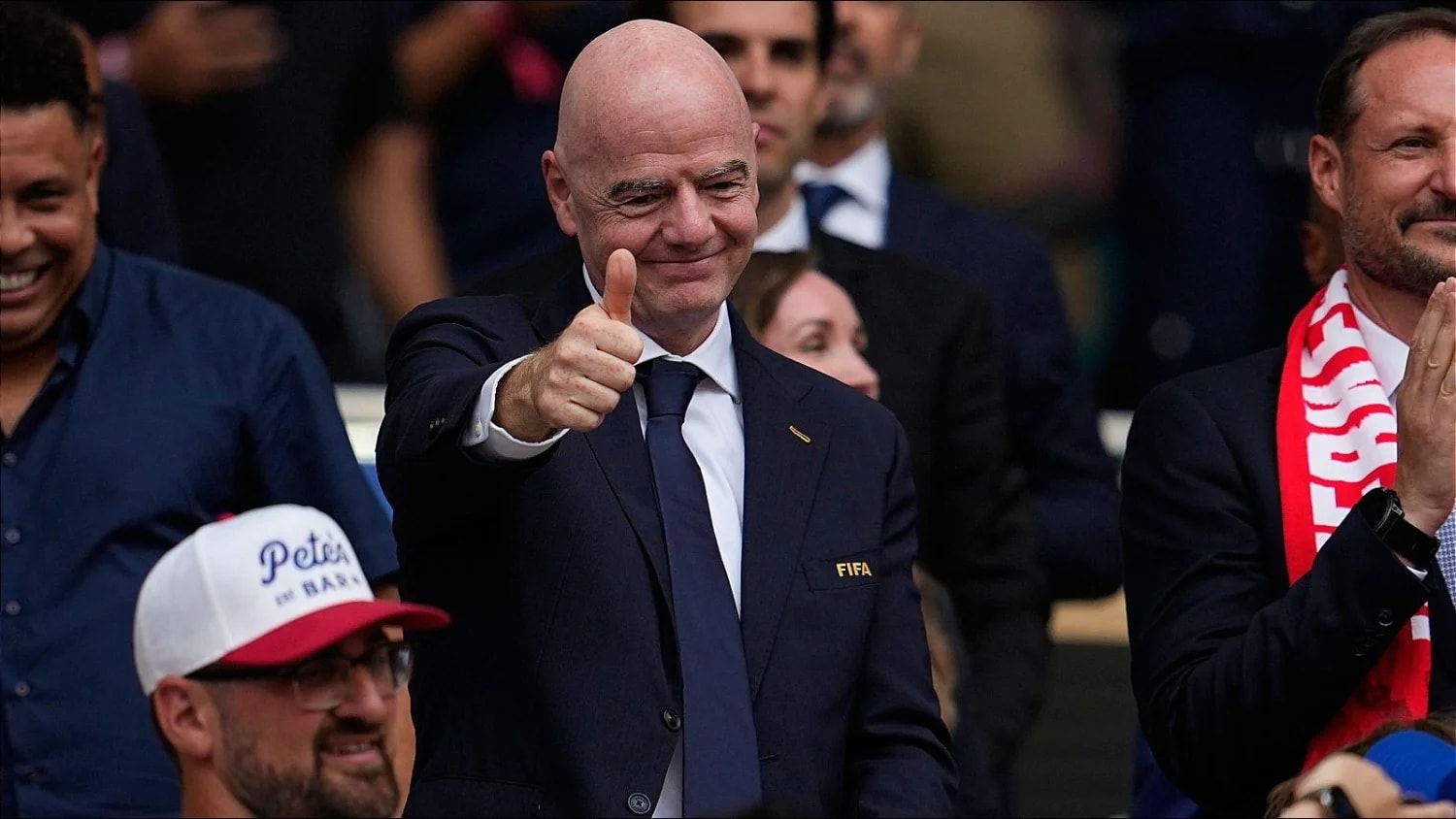
The World Cup in Canada, Mexico and the United States is the first to feature 48 teams, following FIFA's expansion from the previous 32-team format. While the move attracted criticism before the tournament, the competition has largely been praised since kicking off on June 11.
Speaking to Swiss broadcaster Blue Sport, Infantino said FIFA would review the future size of the tournament once the current edition has ended.
"These are all issues that we will be examining after the World Cup," he said.
Infantino repeated his belief that the World Cup should give every nation a realistic chance of qualifying.
"I think it is important that when you want to organise a World Cup, you do it for the whole world - not just Europe and South America, but effectively the entire world," he said.
"Every nation should be allowed to dream of participating in the World Cup. You can see that the quality of the teams is extremely high and it's getting higher and higher all over the world.
"If you don't give smaller countries a chance to participate in the World Cup, they'll lack the incentive to keep improving."
The FIFA president believes the expanded 48-team tournament has already proved its value, pointing to the performances of teams from every continent.
"Every team played at a high level. Teams from every continent scored goals and earned at least one point," he said.
"Nine out of 10 African teams reached the knockout stage. At the last World Cup, there were only five teams from Africa. That just goes to show how important it is to include all teams and give them this opportunity to participate."
The World Cup was previously expanded to 32 teams in 1998. The 2030 tournament will be jointly hosted by Morocco, Portugal and Spain, while Saudi Arabia will stage the 2034 finals.
Infantino also defended FIFA's decision to introduce hydration breaks during matches played in extreme heat, despite criticism that the stoppages mainly benefit television broadcasters.
"This is a topic that sparks a lot of debate," he said. "Last year, during the Club World Cup in the USA, there were cooling breaks whenever it was very hot.
"These short breaks occurred in about 60 per cent of the matches but not in the other 40 per cent because the temperature wasn't as high. There were many complaints, as the feeling was that all teams should face the same conditions."
The FIFA chief also rejected criticism over World Cup ticket prices, highlighting the strong demand for seats.
"The stadiums are full. Capacity utilisation is at 99.7 per cent and it will likely reach 99.9 per cent by the end," he said.
"Our experts determined the ticket prices before the tournament. We see the proof now. Prices that some people claimed were too high are being resold on the secondary market, which is perfectly legal here, for four or five times the original cost."
Infantino added that FIFA expects the 39-day tournament to generate between 13 billion and 14 billion Swiss francs, equivalent to between 14.1 billion euros and 15.18 billion euros in revenue.
"That is quite satisfactory," he said.